
The Bulletin's "Doomsday Clock" Needs A Reset
No one is taking notice of this symbolic gesture for action

The Bulletin of the Atomic Scientists have reset their 2026 Doomsday Clock, and to absolutely no one’s surprise, they have advanced the clock from 89 seconds to 85 seconds to midnight. For those of you who are new to the Clock, the Bulletin has a “Science and Security Board” that evaluates the year’s events regarding nuclear weapons threats, the disruption caused by artificial intelligence, biosecurity concerns (deliberate and natural), and climate change. It’s all averaged into this one symbolic clock face that is intended to warn the public and world governments that time is running out to reverse impending global catastrophes. While I disagree as to where they’ve set the hands of the clock, I generally agree with their concerns (following bullets use their opening statements), if not the setting.
The lack of arms control talks and the general dearth of leadership on nuclear issues (both largely through neglect of the United States)1 has worsened the nuclear outlook. This is an easy call, based on the continued modernization of nuclear weapon systems by the United States, China, Russia, and North Korea; the attack on Iran’s nuclear facility; the destabilizing effects of “Golden Dome;” and the debate over the possible resumption of U.S. nuclear weapons testing.
Reducing the threat of climate catastrophe requires actions both to reduce their primary cause - the burning of fossil fuels - and to deal with the damage climate change is already causing. Record heat levels, droughts, floods, no progress on reducing CO2 emissions - we can argue about the cause, but none of this is good. Every year, there are new records set in terms of hot days and storm damage.
Biosecurity concerns include research into self-replicating “mirror life,” AI technology that can design biological threats, state-sponsored BW programs, and the general collapse of the U.S. public health system. I generally disagree with concerns about the second and third points, but don’t know enough about the first one. Natural disease outbreaks ought to be the sole focus here.
The increasing sophistication and uncertain accuracy of AI models have generated significant concern about their application in critical processes, particularly in military programs. Most of the concern here is more about the potential application of AI tech toward dangerous ends rather than actual incidents or accidents, but sure, there’s a potential risk that requires management.
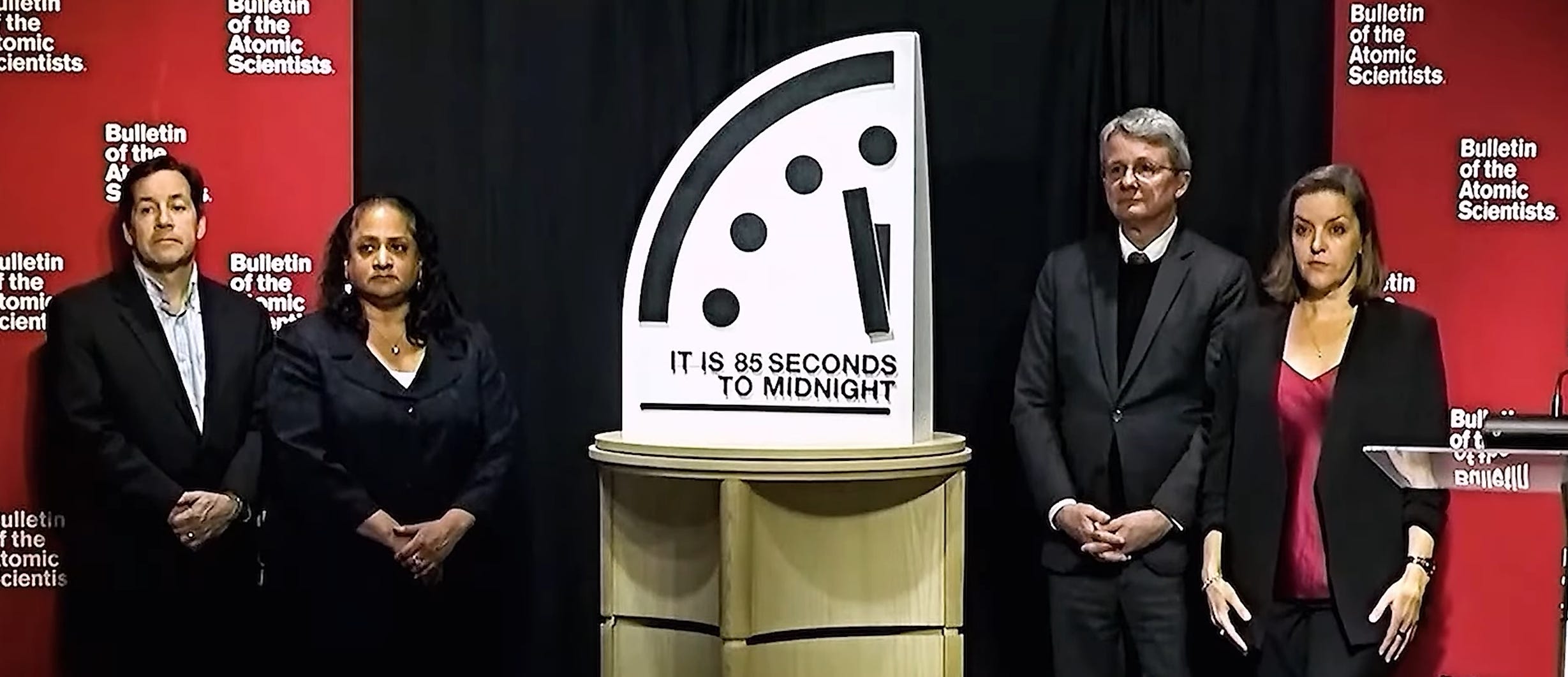
(From left to right, Jon Wolfsthal, Asha George, Steve Fetter, and Alexandra Bell)
Last year, I expressed my dissatisfaction with how the Bulletin’s board developed its analysis and portrayed its findings on a single clock face. I don’t believe the amalgamation of all of these threats on a single risk meter accomplishes their desired goal of increasing public awareness and compelling action by politicians.
I would argue that the Doomsday Clock has been ineffective over the past decade in alerting the public to the threat of global catastrophe. To no small part, this is due to the dilution of its message from warning about the existential threat of a nuclear exchange to include other global threats that, while not as existential, have challenged the stability of international relations. I get it. The world keeps getting more dangerous, and certainly there are things that national leaders (and the United States in particular) could do to lessen these catastrophic threats. But the message gets lost in the simplistic design of the clock and the public’s failure to believe that they can do anything about these complex technical issues.
I still believe this. The Bulletin’s mistake in their calculations is that they always refer to the previous year’s clock, without considering whether they had been perhaps overly pessimistic (e.g., when they went from six minutes till in 2012 to three minutes till in 2015). And here’s the thing. The Bulletin’s board can be sincerely justified in their concerns about the implications of these technologies and how they affect the world. At the same time, they completely miss the opportunity to get the public buy-in because they use subjective judgment and do not have consistent measures of effectiveness. People can’t wrap their minds around multiple existential threats.
In 1949, the Bulletin set the clock at three minutes to midnight because the Soviet Union exploded an atomic bomb. It didn’t have an arsenal, but it certainly foreshadowed the nuclear arms race during the Cold War. Did that single act make nuclear war an imminent threat or was this just a cry for national attention? In 1984, after decades of the clock’s hands swinging as far back as 12 minutes prior, the events of Able Archer and President Ronald Reagan’s aggressive language, the clock was back to 3 minutes. This seems more understandable than the 1949 clock.
Does the Bulletin present a scientific and unemotional analysis that places the hands of the clock on a particular minute? Or is this sensationalistic grandstanding to attempt to influence a broad public audience to “do something.” I suggest that, in order for the Doomsday Clock to be truly appreciated, we need to see what exactly constitutes moving the hands of the clock forward every five minutes from 1100 PM as well as back from midnight. It should not be a subjective evaluation based the rhetoric of particular national leaders or the success or failure of arms control and nonproliferation talks in one particular year. There’s no doubt that setting the clock at seven minutes to midnight in 1947 was an overreaction deliberately intended to highlight the concerns of the time.2 Having seven minutes to midnight in 1960 can perhaps be better understood as well as the case of ten minutes to midnight in 1969. Troubling times then, not so much today.
In 1991, the Bulletin celebrated the end of the Cold War and the signature of START I. The clock was set at 17 minutes to midnight, even as there were still tens of thousands of nuclear weapons in the combined stockpiles of the United States and the Soviet Union. START capped the deployed strategic nuclear weapons at 6,000 on each side, which is four times what we have today. Solely because U.S. and Russian political leaders were talking in 1991, we see this virtual sigh of relief. I will also note that the most significant moves toward midnight were during the Reagan and Trump years - again, based on personalities and not actual incidents.
Let’s experiment with an alternative setting of the clock - just nuclear threats. Let’s set the general baseline of “we think there’s a future threat” at 1100 pm, because, why not. We all understand that “midnight” represents a global nuclear exchange between any two nuclear powers (but the focus is on the possible actions of Russia and the United States). Then use this set of metrics for moving the hands every year.
For every hundred operational nuclear weapons that are “on alert,” add 30 seconds
For every new nation that starts a nuclear weapons program, add 5 minutes
For every terrorist group obtaining special nuclear material to build an improvised nuclear device, add 5 minutes3
If Russia and the US sign a bilateral nuclear arms treaty, subtract 5 minutes
If China and the US sign a bilateral nuclear arms treaty, subtract 5 minutes
For every new regional conventional war started by a nuclear-weapon state, add 15 seconds. For every year that this conventional war continues, add 15 seconds4
What’s that give us? FAS says that there’s roughly 9,600 nuclear warheads in military stockpiles (90 percent of that is US and Russia). That makes it 11:48 PM. Nothing moving on the arms control side, so that’s zero. Russia’s fight with Ukraine adds 2 min 15 seconds, so it’s 11:51:15, around eight minutes until midnight. That puts us roughly where we were in 2000, right after Pakistan joined the nuclear club and when the U.S. and Russia had 7,000 operational nuclear weapons as opposed to the 3,300 operational nuclear weapons that the two states have today.
Are these metrics perfectly sound? Not necessarily. Did I game it a little? Sure. But you can see the math. I would accept other metrics for consideration. There’s a lot more objectivity here that demonstrates analysis of world events and not just subjective feelings about what particular national leaders might do in a crisis or whether these leaders just seem irrational in dealing with foreign policy issues. I’m not trying to downplay the rantings of particular national leaders as unimportant, rather, I believe that risk management has to be developed on an objective basis.
Creating a separate climate clock would, I think, be easier than the nuclear clock. We already have a Climate Clock that sees “midnight” as when the earth heats up more than 1.5 degrees Celsius. If you used a climate clock starting in 1947 along with the nuclear clock, I would argue that the hands would start at11 PM, and midnight represents an irreversibly hot planet that imperils human existence. It’s pretty easy to match the rise in global temperatures to the marks on a clock. Every increase of 0.033 degrees Celsius in global average surface temperature would equal one more minute added to the clock. Given this metric, we’d be around 11:52 or eight minutes to midnight (rough estimate). There might be other metrics one could consider, but I’m not a climatologist. Open to suggestions.
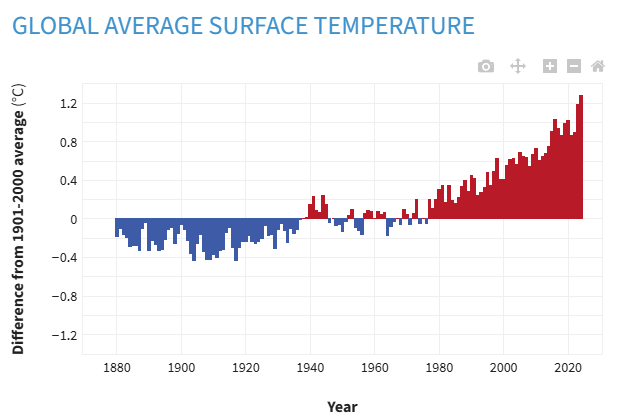
(from NOAA’s climate.gov website)
I think I could take a swing at making a clock for biological threats. I generally don’t like using this term “biological threats.” It’s not at all helpful to lump deliberate biological threats, natural disease outbreaks, and laboratory accidents into one general policy challenge as some do. They are distinct challenges with different threat sources causing different impacts on society, requiring different agencies to implement focused programs. But that’s what the Bulletin does, that’s what the U.S. government does, so what would this look like. I like the date of 1947 (again) for biological threats as this was when the U.S. and Soviet Union started ramping up their biological weapons programs.
Midnight would be one billion cases of people infected by a very contagious and lethal pathogen rampaging unchecked across the globe - released either by Mother Nature or a deliberate act - something we would really want to avoid. Bio is a little harder to measure every year because it takes a few years for governments to work up the statistics as to outbreaks and associated mortality counts. We see 2023 data used to make an assessment in 2025. Also, the tendency is to show the trends of a single infectious disease over time, which may cause some to miss the point that a LOT more people die from noncommunicable diseases than by infectious diseases within the United States, let alone globally. Also, when you look internationally, it’s not COVID killing people as much as tuberculosis, malaria, cholera, and HIV/AIDS.
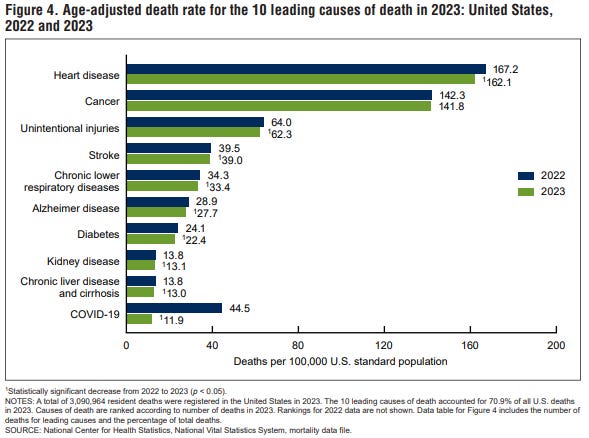
(source, CDC database - note it’s 2023 and not 2025 data)
Some potential metrics:
Every nation-state with an offensive biological weapons program adds five minutes to the clock
Every million people killed by a pandemic in the last year adds 1 minute
Every thousand people who caught a reemerging infectious disease last year adds 30seconds
Every terrorist biological attack that resulted in at least 1,000 people injured or killed in the last year or that significantly impacted out a major agricultural source of food animal or crop adds 3 minutes
Every major incident causing one non-fatal or fatal accidents per 10,000 workers in a BL-3 or BL-4 research laboratory in the last year adds 30 seconds
The unknown potential intersection of AI and biotechnology adds 10 minutes (throwing the doomsayers a bone here)
Every LLM that announces increased barriers to access to biotechnology information subtracts one minute
I estimate that, at the best, this puts the bio clock at 11:40 PM. This requires some elaboration as to how this is measured, but data are out there. There are a lot fewer nation-states with BW programs than there used to be. Also, you just cannot compare the intentions and capabilities of nation-states with BW programs today (the State Department has pointedly looked at China, Russia, and North Korea as candidates) with what nation-states had in the 1960s-1980s. I don’t believe that any country other than North Korea is considering the large-scale use of biological weapons during military conflicts. As for bioterrorism and laboratory biosecurity incidents, you can’t raise the risk based on hypotheticals of increasing bioresearch labs or the general availability of technology causing an increased risk of an incident or accident.
I’m not a public health expert, and I accept the general point that there will be a future pandemic of some sort. I have no illusions as to the growing impact of infectious diseases on the population, and climate change only worsens the situation. The United States and many other nations do not spend enough funding on disease prevention and public health.5 The Trump administration’s actions in slashing HHS research funds, disestablishing USAID, and withdrawing from WHO will negatively impact the U.S. public’s susceptibility to natural disease. But - and you know there was going to be a but - you cannot justify trying to increase attention on natural disease outbreaks by scaremongering people about biological weapons and bioterrorism. Natural disease outbreaks will happen and are a known variable. Nation-states and substate groups using biological weapons is a known unknown variable.
I’m not going to even try to do a clock for the potential risk of “disruptive technology” to include artificial intelligence. I think it’s possible to develop metrics, but who really knows what is going on in this area as far as actions by military agencies and private firms in developing AI models and erecting safeguards. To that point, I don’t think it’s helpful at all to have a clock for the dangers of AI applications until it’s more transparent as to where the trend is going. Until then, everyone can have an opinion. I’d (subjectively) put the clock at 11:26, just because no one has good risk estimates on this issue. What would midnight even mean - a sentient AI overlord that has control to direct military forces? a combination of catastrophic AI attacks that resulted in significant disruptions in critical infrastructure and government services? What about cyber-crimes and deep fakes that influence elections? I just don’t know.
This is what I see. It’s certainly not 85 seconds to midnight. We’re not that close to doomsday by any stretch of the imagination. The Bulletin’s board sees a need to show that this year is worse than last year, so of course they have to move the hands forward from 89 seconds. The movement from year to year is the real reason why they want to use a clock, to illustrate that things are getting worse and that action is required to reduce the risk. But let’s get a grip. It’s not great, but it’s not end-of-the-world bad.
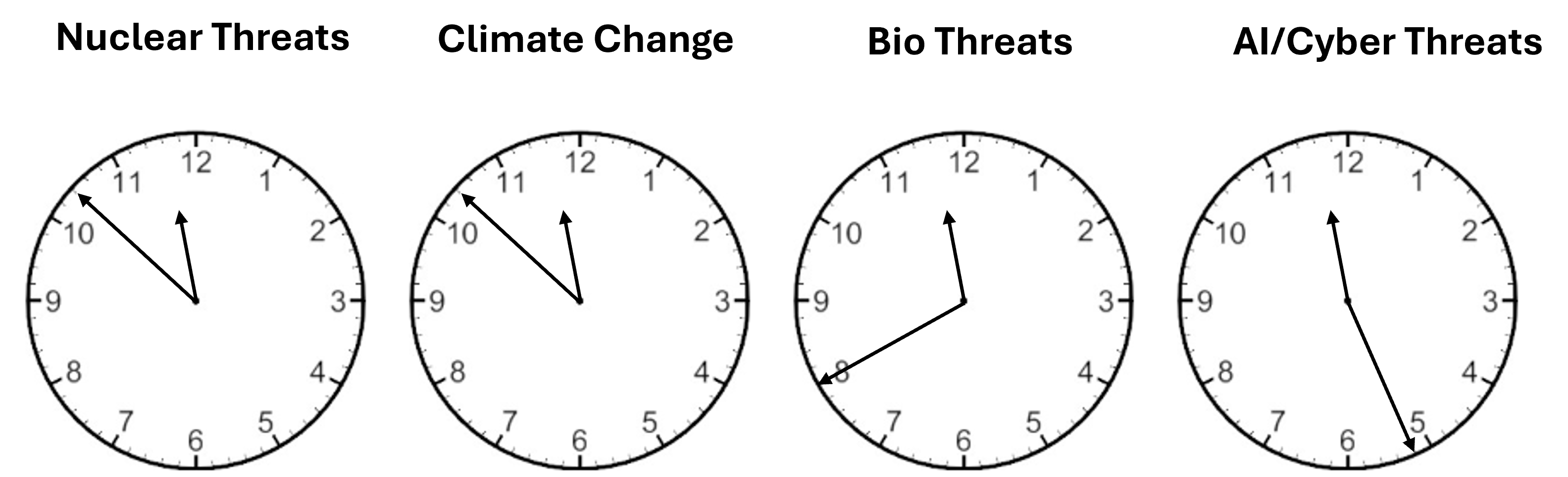
I will wager that the nuclear clock has only moved from 11:50 to ll:48 over the past three years. Not a good trend, and it’s concerning. Climate change probably moved from 11:45 to 11:52 over the past three years. It’s moving more rapidly than nuclear threats and is more concerning, considering that this is something that the major global powers could actually do something about. Bio threats spiked between 2020 and 2021 to 11:45 but it’s fallen back due to the lessening of COVID deaths and lack of any significant bioweapon incidents or laboratory biosecurity accidents. AI/Cyber has been creeping up over the last few years from 11:15 to 11:26, but it’s not a crisis yet.
The Bulletin has correctly identified critical issues pertaining to these national security issues. The national security community within the Beltway doesn’t do enough to talk about pushing the White House and Congress to adopt policy approaches to reduce these risks. Instead, they admire the problem. The Bulletin wants the public to notice and tell their political representatives to do something to lessen this threat, but the public can’t grok the concept of “85 seconds to midnight” and Republican politicians don’t care enough to actually act upon these concerns. Subjective views that are unsupported by evidence or objective analysis, however, is not the right approach. It’s time to reset the Doomsday Clock and encourage the Beltway to have a more focused policy discussion on what we ought to be doing.
They didn’t say that, I’m saying that.
Bulletin member and artist Martyl Langsdorf is quoted as saying the clock was set at seven minutes to midnight in 1947 because “it looked good to my eye.”
Yeah, I know this is pretty far-fetched, but there will be people who say that terrorists are seeking weapon-grade fissile material because, reasons.
This is supposed to reflect the chance of escalation from conventional to nuclear warfare, rather than a “bolt from the blue” attack or a miscommunication or accidental launch.
Public health and health care spending is an amazingly complex topic. I will only say that there’s a lot of focus on natural disease outbreaks because the public doesn’t see it coming and it disrupts their daily lives. At the same time, people don’t seem to be moved by the high rate of noncommunicable disease deaths or relative high costs of U.S. health care.
Just for grins, on the infectious deaths front, I was playing around with a recent version of ChatGPT and asking it about deaths. And it actually gave me decent sources (which is NOT what it used to do, the sources were non-existent or red herrings). Anyway, viruses carry away about 9 million people a year, bacteria almost 8 million, fungi about 2.6 million (most of those are immune compromised) and protozoa less than a million. The latter two categories pretty much cover deaths due to eukaryotic parasites (including malaria). There is some crossover.
Al, I like your rubrics because they're rubrics. If you don't have rules--as you point out--everything is subjective and nobody knows how they are *really* deciding anything other than "I feel anxious about X, Y, and Z". This is one of the insights I got from reading "Thinking Fast and Slow".
I get all the Bulletin emails (they're kind of a burden) and I've had the same thoughts. The cynical me says, "This is a fundraising ploy." but they've got good people there so it can't be ALL fundraising.