
Defining WMD for Policy Issues
Looking past the legal definitions for the purpose of enacting policies

There have been more discussions on the president’s recent decision to declare fentanyl as a chemical weapon through the release of an executive order. I am not sure the two articles discussed below provide a solid case supporting or rejecting the logic in this executive order, but they do point out the importance of understanding why Congress has multiple definitions for weapons of mass destruction. The fact that multiple definitions exist isn’t helpful. Governmental policy is supposed to address specific challenges, and defining the term “WMD” is just a beginning point toward policymaking. There is a lack of consistency, but we ought to focus on what Congress intended to do with each piece of legislation. Let’s first look at these two articles.
This article by David Del Terzo and James Dunne is titled “When Is a Drug a Weapon? The Legal Puzzles of Designating Fentanyl a ‘Weapon of Mass Destruction.’” It is a pretty good analysis of the different legal definitions of WMD and the implications of the president’s executive order on this issue. The authors do not come out and say that the president’s order is ridiculous, as students of law might do, but they point out some potential obstacles to its implementation.
First, fentanyl is not designed or sold as a weapon. It is a pharmaceutical developed and commonly prescribed in the United States since 1968 for legitimate medical use as an analgesic (pain reliever). And even illicit fentanyl is manufactured and distributed as a drug—something users intend to consume for its psychoactive effects, not as an instrument of harm against others. The deaths fentanyl causes are predominantly overdoses among users, not attacks by traffickers against victims.
Second, traffickers do not intend to kill their customers. Drug dealers have obvious economic incentives to keep their clientele alive. While they may be reckless or indifferent to the risk of overdose deaths, this falls short of the specific intent to “cause death or serious bodily injury” that § 2332a contemplates. The statute historically has been applied to terrorist plots and attacks, not commercial transactions with tragic consequences.
Third, the “release, dissemination, or impact” language connotes a mode of delivery characteristic of chemical weapons: dispersal into an environment to affect those present, rather than the voluntary consumption model of drug transactions. For example, sarin is “released” into a subway; fentanyl pills are sold to willing buyers.
Absolutely correct. This is a slightly long discussion, but it’s a good read. I cannot, however, say the same about this article talking about remarks made by David Lasseter, who was the Deputy Assistant Secretary of Defense for Countering WMD for about a year at the end of Trump’s first term. At the least, he’s not making the case that fentanyl is a WMD, but rather, he proposes a notional scenario in which a shadowy terrorist group might, some day in the future, develop an aerosolized fentanyl bomb.1
"The President took a big stand here, and I think he made the right choice," he said. "You know, we used to hold these up in the Pentagon. It's a sugar packet, five grams or so (of fentanyl) that can kill hundreds of people if weaponized," he added. "And so, you know, the President pointed to numbers, small numbers in the executive order that can kill an individual if consumed. But if weaponized, it could kill a lot more."
What horseshit. “If weaponized” is carrying a lot of weight for an argument about something that hasn’t happened since 2002. There’s always a fantasy scenario for these guys. An unknown terrorist group might move a nuclear weapon into the United States. An unknown terrorist group might use artificial intelligence to make a genetic weapon. An unknown terrorist group is going to use drones and chemical weapons to kill crowds of people. It’s always a notional terrorist group that has unlimited resources and has somehow stayed under the radar of law enforcement.2 All things (that have never happened) are speculated upon based on the acceptance of technological determinism - the idea that because a particular technology exists, its future use will be unstoppable.
The reason why there are WMD definitions in public law is because Congress intended specific agencies to take specific actions regarding the threat of adversarial nations or sub-state groups who might seek to use them. It’s not the definition that is important, it’s the authorities granted to these executive agencies. When people try to broaden or misuse the term “WMD,” often it is because they want those executive agencies to do more than what they are currently doing in some regard. It becomes important, therefore, to understand how Congress has developed public law to address chemical weapons specifically and WMD in general.
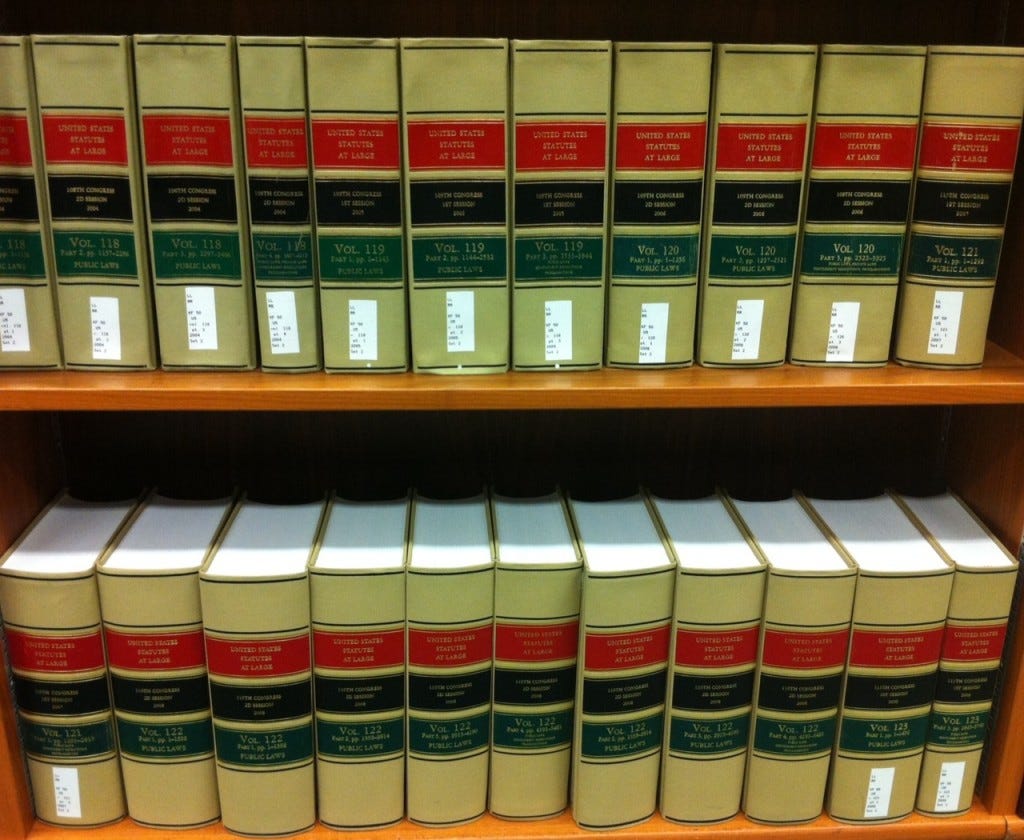
First, if it needs to be said, you have to read Seth Carus’s “Defining Weapons of Mass Destruction.” It’s the fundamental basis for having any discussion on definitional issues surrounding WMD policy. For those of you who have already read the monograph, I’m struck by this very clear conclusion.
Over time, WMD has acquired additional meanings. Some of these alternative meanings resulted from application of the term to contexts outside of diplomacy, like when the Soviet Union integrated it into its military doctrine. In other cases, such as the 1961 DOD definition, government officials created alternative definitions to shape bureaucratic agendas. Such definitions, however, are now less significant than the relatively recent inclusion of high explosive weapons as forms of WMD. This formulation, which first appeared in the Violent Crime Control and Law Enforcement Act of 1994, turns the original meaning of WMD on its head. Although the original definition of the term explicitly excluded high explosive weapons, the U.S. Congress created a completely new definition that fundamentally altered the term’s meaning. In the absence of legislative history, it is only possible to speculate on the rationale for the new definition.
The confusion resulting from the adoption of inconsistent definitions creates problems with use of the term. Ideally, those who use the term should rely on the original, canonical definition developed by the UN and now enshrined in international law. It is unlikely that the U.S. Congress or the law enforcement and defense communities will follow such a path. For that reason, it is essential that the specific meaning intended is evident whenever the term is used.
I’ve had a particular disdain for all of the DoJ lawyers and FBI investigators who claim that WMD includes pipe bombs, innocuous white powders, and radioactive sources. Not that there haven’t been DoD CWMD persons who do the same, trying to open up new funding opportunities increase collaboration across executive agencies. I believe that a WMD has to be 1) a designed weapon that, 2) potentially causes mass casualties (over 1000 dead and/or injured), and 3) is defined by the United Nations as an unconventional weapon. None of the U.S. legal terms meet these simple requests.
There are people who will cherry-pick a definition of chemical weapons or WMD out of the public law or other sources for their own personal agendas. There are other people who don’t understand the rationale for why a particular legislative statue exists for WMD issues. I’m going to quickly summarize the major U.S. codes on chemical weapons to make this point that, yes, there are different definitions in the public law, but when one looks at them in context, then one can understand why these laws exist.
6 US Code Chapter 1, subchapter XIV (sections 590-597), [DHS] Countering Weapons of Mass Destruction Office, created in 2018. Congress directed that DHS retain a CWMD Office when, in Trump’s first term, it looked like he was going to kill it. However, the legislation stated that the office would terminate in December 2023. This deadline was extended by a year due to a continuing resolution to February 2024. DHS has since disbanded the CWMD Office and transferred its roles and responsibilities to other offices. In 6 USC 590, it refers to the WMD definition in 50 USC 1801 (below).
10 US Code 282, Emergency situations involving WMD, created in 1996. This legislation was added after the Aum Shinrikyo subway attack in 1995, meant to authorize U.S. military forces to support civil law enforcement in response to a domestic chemical weapons incident, subject to such assistance not adversely affecting U.S. military preparedness. The Trump executive order on fentanyl cites this act, but it absolutely does not apply to the case of military interdiction of illicit drug shipments. No definitions of chemical weapons or WMD.
18 US Code 229F, Definitions for Prohibited Activities, under Chapter 11B, Chemical Weapons, created in 1998. Linked to the implementation of the Chemical Weapons Convention treaty to stress that it is unlawful for any person to knowingly develop, produce, receive, retain, possess, or use, or threaten to use a chemical weapon. It uses the CWC’s definition of chemical weapons, in particular, “specifically designed to cause death or other harm through toxic properties.” See 22 USC Chapter 75 below.
18 US Code 2332a, Use of weapons of mass destruction, created in 1994. This is the most popular legal definition. As Carus notes, it was added through the Violent Crime Control and Law Enforcement Act of 1994 (interestingly prior to Aum’s attack). The purpose of this law was to simply provide federal prosecutors with the ability to charge “terrorists” - however you want to define that - with a death sentence “or imprisonment for any term of years or for life.” Prior to 1994, this specific capability was not available. It does define chemical weapons and other WMD with a very broad brush.3 There’s no limitation to, say, the CWC’s list of chemicals of concern or the Federal Select Agent Program. Absolutely no metric of what “mass casualties” or “mass destruction” is, but the important part is, it specifies the use of weapons (not the transfer of illicit drugs). Can apply to improvised explosive devices or a small vial of a hazardous chemical that came from a high school laboratory.
22 US Code Chapter 75 (sections 6701-6771), Chemical Weapons Convention Implementation, created in 1998. Pretty self-explanatory, the legislation intended to turn the CWC treaty into U.S. public law for the purposes of implementing the convention in terms of requiring affected parties to make declarations and submit to inspections, etc. It uses the CWC’s definition of chemical weapons, in particular, “specifically designed to cause death or other harm through toxic properties.” The FBI tried to use this code to prosecute Carol Ann Bond, who used a toxic chemical to attack her husband’s mistress. The Supreme Court ruled that this code did not apply to the circumstances of this case and overturned her conviction.4
50 US Code Chapter 32 (sections 1511-1528) addresses the U.S. Chemical and Biological Warfare Program, created in 1969.5 More to the point, the DoD CB Defense Program was legislated into public law in 1993 (section 1522). In 50 USC 1519, it identifies toxic chemicals in the context of “lethal binary chemical munitions” as those intended to be used to produce injury or death to human beings. There is a very broad definition in 50 USC 1520 for “biological agent” for the purpose of addressing human subject testing. In 50 USC 1521, the law defines “lethal chemical agents and munitions” as those “designed to cause death, through its chemical properties, to human beings in field concentrations.”
50 US Code 1801, Definitions for Electronic Surveillance (under the FISA), created in 2008. Gives DoJ authorizations to use electronic surveillance without a court order and, in the case of a potential use of WMD by a foreign power, allows for coordination with Federal and state law enforcement officers on collecting said information. Defines WMD along the lines of 18 USC 2332a, again stressing the part about devices that are designed, intended, or has the capability to cause death. Of particular interest, this part of the law amends 18 USC 2332a by adding a metric of mass casualty, notably “a significant number of persons” must be harmed. It’s not a great metric, but it’s more than one person, which is the measure used in 18 USC 2332a.
50 US Code Chapter 40 (sections 2301-2371), Defense against Weapons of Mass Destruction, created in 1996. This is a long piece of legislation, written originally to authorize the DoD to support the Domestic Preparedness Program, which spent funds to “train the trainers” in 120 cities, later repealed when the DoJ took over the program. This included a partnership of sorts with FEMA on preparing the public for such an incident. Broadened to include the procurement of radiacs for the Border Patrol, working with the Russians on nuke/rad terrorism, and creating a national coordinator on nonproliferation and a Nonproliferation Center under the CIA.6 Section 2302 defines WMD as “any weapon or device” that can “cause death or serious bodily injury” as a result of toxic chemicals, disease organisms, or radiation. Very general. Section 2351 calls for a “National Coordinator on Nonproliferation” but says that this office can go away in September 1999. Unclear that anyone filled that role.
50 US Code Chapter 43 (sec 2901-2932), Preventing WMD Proliferation and Terrorism, created in 2007 to enact the Proliferation Security Initiative and direct DoD and State to develop roles and responsibilities regarding the interdiction of WMD program-related materials and technologies with the cooperation of other states. It defines WMD under section 2902 to include “chemical, biological, and nuclear weapons, and chemical, biological, and nuclear materials used in the manufacture of such weapons.” Also calls for the appointment of a “Coordinator for the Prevention of WMD Proliferation and Terrorism” that absolutely does not exist today.7 Again there was this sense of Congress that the United States ought to work with Russia on this issue.
The point of this exposition is to stress that it is not enough to just argue about the term “WMD” and what specific materials fall under that general category. This path leads to madness. It is the realm of the technologists who are trying to get more funding for their acquisition programs and the war hawks who are looking for excuses to invade particular “rogue” countries. The development of sound national policy requires that one enter the discussion in the context of which the issue is being debated and what outcome is desired. There is no single section of law addressing WMD because it depends on what actions one expects the U.S. government to undertake with respect to WMD activities. Is it about the arms control regime? Is it about WMD terrorism? Is it about directing the DoD to support another federal agency? Is it about gaining the cooperation of other nations? These all require specific legislation to enable the U.S. government to take action. That’s the point of policy. It (supposedly) points directly to the specific problem and expected actions and outcomes. These definitional arguments are distractions from the need to develop capabilities to prepare for a particular set of unconventional weapons.
It should go without saying that the above examples in public law do clearly illustrate the intent of Congress to address military weapons as opposed to illicit drugs. There are many other legal avenues to address the illicit drug trade, which I will not list as that’s not my area of expertise. Illicit fentanyl is not a chemical weapon. Move on.
To be brutally honest, the Trump administration would have been on much firmer legal ground by going with 50 USC Chapter 43, the implementation of PSI to interdict WMD program-related materials and technology. The reference to 10 USC 282 in the executive order just makes no sense and doesn’t help their case. They still are wrong in declaring that fentanyl was a WMD, because drug cartels are not developing fentanyl as fills for chemical weapons, but at the least, Congress would have had a correct point of reference as to what the White House intended to do.8
Any White House administration or Congress ought to be invested in the development of good public policy that addresses real challenges to the American people. Sure, there ought to be more consistency in the definition of WMD and chemical weapons, but that shouldn’t stop the intent of using the right legislation to address the particular national security challenge under review. Words matter.
(Updated version, thanks to a good friend and colleague).
To be clear, he’s not a bad guy, he’s had better CWMD narratives (see here). But his argument here is speculative and not helpful.
Funny how these guys never talk about a nation-state trying to build unconventional weapons for the purposes of attacking the United States. No nation-state is that suicidal, especially after 2003. Well, except for maybe China and Russia, and even they aren’t making chemical or biological weapons for military operations against another nation-state, really.
Per 2332a: the term “weapon of mass destruction” means—(A) any destructive device as defined in section 921 of this title [using explosives, incendiaries, or poison gas]; (B) any weapon that is designed or intended to cause death or serious bodily injury through the release, dissemination, or impact of toxic or poisonous chemicals, or their precursors; (C) any weapon involving a biological agent, toxin, or vector (as those terms are defined in section 178 of this title); or (D)any weapon that is designed to release radiation or radioactivity at a level dangerous to human life; and (3) the term “property” includes all real and personal property.
The difference between 18 USC 229 and this section is that the former is intended to prosecute nongovernmental and/or unauthorized persons handling chemical weapons and the latter details what the U.S. government is supposed to do to implement the treaty.
The U.S. government had an offensive chemical and biological weapons program at the time. The BWC was opened for signature in 1972 and entered into force in 1975. Various related domestic issues in 1968-69 caused this flurry of Congressional interest.
I have no knowledge of this center or coordinator. Maybe this was the WMD Czar? Assuming it was cancelled under the Bush 43 administration.
I’m confused by the title, I’ve never heard of such an office. A colleague suggested that this was an office within the National Security Council staff between the Senior Director and Deputy NSA. Congressionally mandated positions within the White House are subject to testifying before Congress and the FOIA.
Even as I’m saying this, I recognize that the Trump administration would be on seriously negligent grounds in that PSI is supposed to be based on respecting existing maritime and international law and ought to favor boarding parties than blowing ships up.
This seems simple to me.
Fentanyl distributed as an illicit drug is not a WMD in any technical, legal sense, though one can politicize the label, and the administration's recent order is incoherent.
On the other hand, fentanyl weaponized by either a state or a non-state actor, to the extent that has or might happen, is unequivocally a WMD under every definition.
Al, drugs are a weapon that some of our citizens pay to attack us. The terminological weaponization of non-weapons is just part of the artful dodgery that we have become used to in America. Orwellian.