
Worrying about Nuclear Armageddon
Maybe you need to seek professional help.

I need another week to do some number-crunching for the DoD CB Defense Program’s POM Budget. There’s some considerably interesting malarky going on that I have to outline. As a result, this will be a short filler post. I thought, with all the hoopla about AI search engines, I would ask ChatGPT about when a nuclear war might occur, sooner or later? I was not encouraged by the answer.
No one can predict the future with certainty—but a full-scale nuclear war is not considered likely, even though the risk is never zero.
Here’s the grounded reality:
1. Deterrence still works
Since World War II—and especially after the bombings of Hiroshima and Nagasaki—nuclear-armed countries have understood that using these weapons could mean mutual destruction. This idea, often called Mutually Assured Destruction, has made leaders extremely cautious.2. Close calls have happened
We’ve come uncomfortably close before—like during the Cuban Missile Crisis. That’s important: it shows mistakes, miscommunication, or escalation can create real danger even if no one wants a war.3. Today’s risks are different
Modern concerns aren’t just big superpower wars. They include:
Regional conflicts escalating (for example, tensions involving Russia, United States, or China)
Smaller nuclear states or unstable leadership
Accidents, cyber interference, or false alarms
4. There are guardrails
Treaties, communication hotlines, and global pressure (through groups like the United Nations) are all designed to prevent escalation. Even rivals usually maintain backchannels to avoid catastrophic misunderstandings.Bottom line:
A nuclear war is possible—but still unlikely, because the consequences are so extreme that most decision-makers actively work to avoid it.If you’re asking because this is weighing on you, it might help to focus on what’s actually within your control day-to-day. Constantly worrying about worst-case global scenarios can drain your energy without giving you any leverage. If you want, I can walk through what warning signs experts actually watch for—so you’re informed without spiraling.
Excuse me, WHAT? I’m a national security professional, not a psychiatric case. The scenario of a nuclear crisis is real, not imagined. How does ChatGPT decide that I need therapy rather than to acknowledge that the continued proliferation of nuclear weapons is a real issue. But hey, AI, right? Why ask for nuance from a non-sentient word-scraper that doesn’t adequately address real-world questions?
Actually, the first part of the answer isn’t that bad on general principles. But … yeesh. Its attempt to counsel my fears? Come on. Get better, ChatGPT.
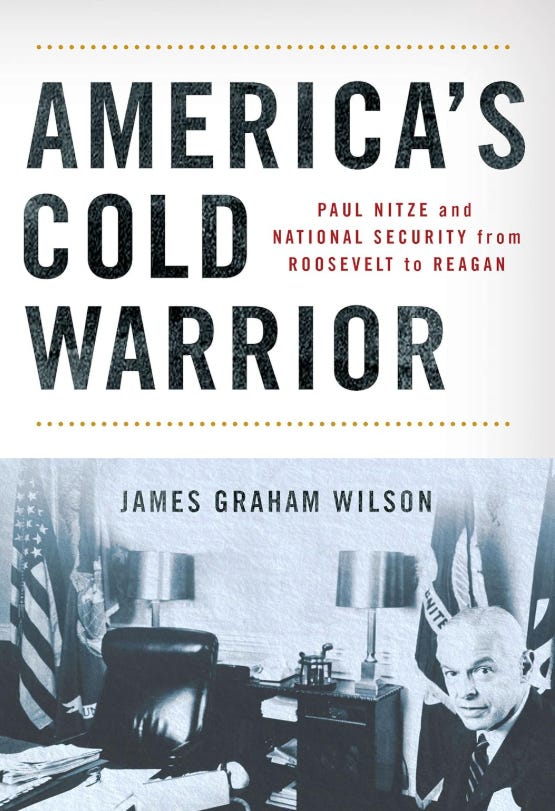
Anyway, screw those guys. I wanted to briefly talk about another guy who worried about the potential of a nuclear Armageddon. I just finished reading the book “America’s Cold Warrior: Paul Nitze and National Security from Roosevelt to Reagan,” written by James Graham Wilson (Cornell Univ Press, 2024). I’ll readily admit that, prior to reading this book, I thought Nitze was just a Cold War hawk who reflexively wanted the United States to have more nukes than the Soviet Union because they were the bad guys. I thought NSC-68 was a particularly hyperbolic discussion about the need to increase the military instead of accepting a more diplomatic approach to contain the “Evil Empire.” His attempts to push for increased defense spending through the Committee on the Present Danger seemed particularly militaristic.
There’s no doubt that he was a natsec hawk, but his career was particularly interesting as he navigated through the various presidential administrations between 1940 and 1985. He left his mark on arms control as well as national security issues. The author does a remarkable job covering this broad career as well as pointing out when Nitze failed in his attempts to influence his political masters. Nitze moved between public service and private organizations smoothly, which was enabled in part by his financial acumen. While not educated in international relations or security studies, he took to the issue of nuclear weapons adroitly and left a strong mark there. What I had not heard before is this construct called the “Nitze scenario.” From the book:
In the Nitze Scenario, the Soviets could launch a “counterforce” first strike that limited US civilian losses while simultaneously sending a message to the US president: surrender or die. The US president could then call on second-strike forces at sea or in the air to retaliate against Soviet cities—which would by then have been evacuated or sheltered—after which the Soviets would still have sufficient forces to take out US cities. Or, the president could surrender, avert a partial genocide of Soviet citizens, and save one hundred million US lives. The chances of that second response happening were extraordinarily slim—but not impossible. Its plausibility, however, emboldened Soviet risk-taking in all contested areas of the Cold War. Nitze felt sure the Soviets knew they could press their advantage because any US president would fear that a crisis like that in Cuba would result in a reversed outcome. At some point, the United States would have to back down, as the Soviets had done in October 1962. From 1975 onward, Nitze worried over the psychological consequences of the Soviets building enough SS-18 missiles to take out the entire US Minuteman fleet.
This led to his push for “strategic stability” between the two nuclear superpowers, in which he pushed for ramping up the number of US nuclear weapons to at least match the Soviet arsenal. I’ve often heard people talk about the “bolt out of the blue” scenario - often derisively - but didn’t realize Nitze’s conceptualization of the concern and his steady focus on developing defense policy toward reducing that perceived vulnerability. Later in his life (post-Gulf War), he changed his position toward a view that maintained a nuclear arsenal but not on a first-use basis.
“The lessons of the military utility of nuclear weapons must … be re-examined and frankly acknowledged,” as he put it. “We will never be certain what has deterred the use of nuclear weapons since 1945. We can speculate that the strategic nuclear arsenals in their morbid way did stay the use of these weapons, that mutually assured destruction may have prevented the use of nuclear weapons against other nuclear powers.” However, in reality, “using nuclear weapons has never entirely been ruled out, and much of the debate of operational nuclear strategy during the Cold War reflected this reality.”
“What inhibited the American use of nuclear weapons was clearly sensitivity to the implications of the destructiveness of such weapons,” Nitze said. “And however much U.S. military doctrine asserted otherwise, their use was never an easy option for the United States, and some troublesome governments have known this and exploited it as a weakness in U.S. military posture.” During the MacNamara era, the aspiration toward flexible response may have led to “a more credible U.S. military presence and deterrence for some situations,” yet “it was a one-time strategic deterrent” in the conflict with the Soviet Union (and fortunately the country had never found out what happened when deterrence fails). Nonnuclear options in the post-Cold War were more promising. “Developing true strategic conventional weapons offers us a flexible capability that no aggressor can discount safely in a wide range of circumstances.”
In a way, Nitze’s late conversion to a nuclear moderate reminded me of a group of senior defense policy leaders who had a similar change of heart. George Schultz, William Perry, Henry Kissinger, and Sam Nunn all were deeply engaged in nuclear weapons policy during their time in government service and then had an epiphany in the late 2000s to voice their concerns that the world needed to get rid of nuclear weapons. Nitze joined the Reagan vision to see a world free of nuclear weapons; he didn’t support such a vision during the 1980s, but he came to acknowledge the point that precision-guided missiles were much more useable in modern conflicts than nuclear weapons were.
I’m not going to review the entire book (disclosure, the author sent me a free copy), but it’s a good read. Nitze had a remarkable career and his influence on national security policy remains even today. It’s worth your time to consider this book. Also, worry more about the possibility of a nuclear Armageddon. Not enough people seem to think that nuclear conflicts continue to be a contemporary issue, and we need to consider what happens after the first missiles fly.
I think we fail to fully appreciate potential lessons learned from a figure like Nitze as long as any analysis is packaged as a fundamentally (and irrevocably?) "Cold War" story. I mean, of course -- obviously -- he was a figure of the Cold War... but that is to say he was a natsec professional between 1945 & 1989. There is a certain way in which some folks portray the Cold War that makes it appear so uniquely distinct or distant that it serves no other purpose than as fodder for interesting history--lots of material for good biographies or spy stories, but about as relevant in day-to-day terms as discussing the Napoleonic wars.
I jest only a little. What Westerners call the "cold war" is hardly ancient history to the strategists in New Delhi or Islamabad. Actually, the better way to see things, perhaps, is that not only is what we call the "Cold War" as relevant as ever, but that, in fact, it can only be understood as part of a strategic continuum that actually very reaches back to the Napoleonic era while stretching forward into the near future. Nitze & his contemporaries did not create artificial distinctions between their strategic reality and that of Napoleon. The great strategists of that era were all versed in history.
Today we're in weird spot--on the one hand, the rise of terminology like "great power competition" is actually reassuring if it means folks are willing to recognize that our 21st Century selves aren't actually that special... that maybe we can learn a thing or two from the past (even in an age of ChatGPT). On the other hand, the people spouting such terminology often come across as if they invented the wheel or split the atom. They haven't even re-invented the wheel.
I look forward to picking up this book--not implying at all that Wilson is guilty at all of this "Cold War is just interesting trivia" view of the world. Rather, it was the anecdote about ChatGPT that seemed to underscore to me a certain kind of 21st Century hubris. Perhaps it's fitting that the ultimate manifestation (so far) of the 21st Century -- that is, AI -- was seemingly downplaying the risks & lessons of nuclear conflict.
The “Nitze scenario” was a completely artificial construct. The Soviet Union had neither the intent nor the capability to anything like that. Interestingly, this line of thinking - the US building damage limitation capability (which is what Nitze was essentially saying the Soviet Union had) - is what seems to be driving most of the US nuclear debate.