
Military.com Doesn't Understand Chem-Bio Warfare
I mean, not entirely surprised, but it is supposed to be a source of military-related news

A colleague passed along a Military.com article that purported to discuss the soon-to-be departed Director of National Intelligence Tulsi Gabbard and her love affair with the DoD Biological Threat Reduction Program (BTRP). Of course, you loyal readers know that I recently opined that the DNI was a Russian mouthpiece and was completely irrational in her attacks on this program. Imagine my surprise, then, when this Military.com journalist decided to uncritically report the DNI’s recent action to out the Ukrainian biological research labs as “likely [to have] housed dangerous pathogens and remained vulnerable to Russian attack, seizure or accidental damage during the war.”1
A good majority of the article merely repeats Gabbard’s claims as to her “investigation” into the potential gain-of-function research being conducted in Ukraine (there was actually no actual evidence to that point in her documents, such as they were). The Military.com journalist attempted to tie in two other unrelated biosecurity incidents, so as to … I don’t know, scare people about biological outbreaks?
The release arrives amid several unrelated cases that have heightened public concern about biological oversight and pathogen security.
In Nevada, investigators discovered what authorities described as an unauthorized biological laboratory operating from a residential property in Las Vegas. The investigation led to the seizure of biological materials and laboratory equipment, although some federal charges connected to the case were later dropped.
At the beginning of June, federal prosecutors charged two NIH researchers with allegedly smuggling biological materials, including deactivated monkeypox samples, into the United States from the Republic of Congo.
Those cases are unrelated to the overseas laboratories identified in Gabbard’s release. Together, however, they have intensified scrutiny of how governments, researchers and public health institutions manage dangerous biological materials.
The debate is no longer whether U.S.-supported laboratories exist overseas, as the newly declassified documents establish that they did. The larger question raised by Gabbard’s release is whether Congress, policymakers and the public had a complete understanding of how many facilities existed, what research they conducted, and what pathogens they contained.
The fact that there were U.S. funded biological research facilities in Ukraine was never a secret. It may not have been common knowledge in the public arena, but the BTRP always was a little obscure, even for the DoD. Gabbard had been talking about them since 2022, as I’ve noted in my coverage, and the State Department was very clear in a rebuttal to Gabbard as to the labs’ presence and what they were doing with U.S. funding. If Congress wanted a briefing on BTRP, there would have been no surprises and no action required. Now, if you want to make the argument that Congress does not adequately perform oversight of U.S. biological research within the United States and overseas, sure. But that doesn’t make the BTRP a threat. For that matter, the Las Vegas and mpox incidents were a pretty big nothing-burgers also, but hey, it’s rare to get a journalist who understands biological research and risk analysis.
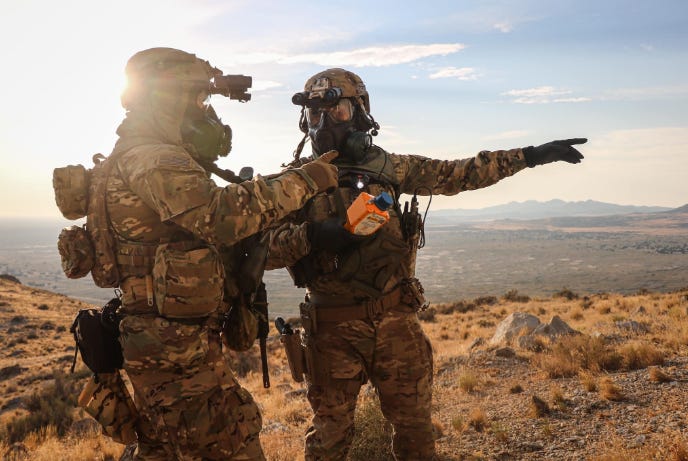
(They still do testing at DPG, using simulants outside and live agent in test chambers)
As I looked at the Military.com’s coverage of other CB warfare issues, such that it is, I noticed that another one of their journalists decided that the 1968 Dugway Proving Ground sheep incident hadn’t gotten enough attention in the past 55-plus years and had to revisit “the Military’s use of illegal chemical weapons.” That’s the actual introduction. I’d love to just have five minutes with the editor who approved this line to at the least explain to him that IT WASN’T ILLEGAL TO HAVE CHEMICAL WEAPONS IN 1968. YOU MORON. Honest to gods.
This article is just filled with misstatements and a complete lack of interest to, you know, actually provide any new insights on a very old incident. For instance, it talks about the F-4 fighter plane that was the alleged source of a VX-agent leak that killed thousands of sheep in a nearby valley.
For the third, an F-4 Phantom flew with two TMU-28B spray tanks, each loaded with 160 gallons of VX. The mission required dispersal over a target area 27 miles west of Skull Valley, then a climb out of the drop zone.
One tank did not empty fully during the pass.
As the jet ascended after completing its run, residual VX continued leaking from the dispenser and trailed into a higher atmospheric column. Wind carried the chemical northeast, across the mountain range separating the proving ground from the ranches beyond. It reached Skull Valley before the next morning.
The test data on this particular flight says that one of the tanks was deliberately half-opened and the other one was fully open. It wasn’t a “leak.” They actually accounted for nearly all of the VX spray in the trial, except for about two percent of the agent in the tanks. If you read the government report, you would have perhaps questioned how five gallons of liquid chemical agent traveled between 30-80 miles on the wind, flowed over a mountain range to strike down thousands of sheep, without harming any horses, rabbits, dogs or cats, or (most importantly perhaps) humans in the area.2 You know, details like that make one recognize the need to understand physics.
Scientists from the National Communicable Disease Center in Atlanta collected water, forage grass, blood and liver tissue from the area. Their analysis found the compounds recovered were “identical” to Army-supplied VX and could “only be attributed to the same chemical.”
When the die-off ended, roughly 6,400 sheep were dead. Another 600 animals too damaged to survive were slaughtered. Many hundreds more were potentially contaminated, preventing them from being sold for profit.
That’s not exactly true. The tests identified organophosphate radicals that could have come from commercial pesticides as well as the nerve agent. In addition, the ranchers claimed that there were 4372 sheep dead and 1877 disabled sheep, the latter of which were shot (most of them were shot and quickly buried, rather than dying from nerve agent exposure). There wasn’t any data on low-agent effects on sheep at the time (because why would you need that), so the Army tested its VX nerve agent on some sheep. The test sheep either died quickly from VX exposure or recovered completely. Some of the test subjects’ symptoms were the same as the ranchers’ sick sheep, but many of the sick sheep had significant characteristics that were not symptomatic for nerve agent exposure. The sick sheep lingered for weeks and didn’t respond to atropine therapy.
Dugway officials told reporters in the days after the deaths surfaced that no chemical weapons testing had been conducted in the relevant period. That stance lasted one week. On March 21, 1968, Utah Sen. Frank Moss, a Democrat, released a Pentagon document confirming the March 13 VX spray operation.
The Army shifted its stance but did not acknowledge fault. Brig. Gen. William W. Stone led a formal investigation that generated more than 1,000 pages of findings.
BG Stone came from Headquarters, Army Material Command, and he had been told by the Army brass to close out this investigation as quickly as possible. There were significant points of debate between the DPG scientists and the Edgewood scientists who also ran tests. The state politicians were angry that the Army was investigating the case, as they believed the Army was at fault and had to make good on their uninsured sheep losses. All the Army leadership wanted was to pay off the ranchers, not admit to anything, and get back to CB weapons testing. This was during the peak of the Cold War, after all. There had been many other open-air tests and never an incident where the agent got off the reservation.
Oh, by the way, Dugway Proving Ground is over 800 thousand acres—more than 1.2 million square miles. The VX test was pretty much in the center of the reservation. The Army had done over 100 spray trials since 1953 without incident. Do the math.
The Military.com journalist does accurately report what happened next. Congressman Richard McCarthy started an investigation, they found out about the Army’s dumping chemical weapons into the ocean, a nerve gas leak in Okinawa (the location of chemical weapons in Okinawa was classified at the time), the use of Agent Orange and riot control agents in Vietnam, it all caused a big stink in the national news. As a direct result, Congress passed legislation saying that the Army could only do open-air testing if the President asked Congress to do so in the sake of national security. That’s still the guidance today. Congress did not prohibit open-air testing, but the Chemical Weapons Convention prohibits testing chemical weapons. One might make a case for using a small dispersal device, not a weapon, in the open environment to test the efficacy of chemical defense equipment.3 It would be very hard to get any open-air tests going again, no matter what scale the test was.4
All to say, sure, this coverage of the 1968 Dugway Proving Ground is factual but biased against the military and unquestioning in its review of an ancient incident that did not harm any people. For some reason, I would have thought that a news site primarily interested in military issues would, I don’t know, actually examine this incident from the military’s point of view instead of the yellow journalism that told the story in the late 1960s. This Army-bashing been done to death over and over again, in print as well as in YouTube videos, and absolutely no one needs to hear this one-sided story again.
Military.com, do better. Give me a call if you want a critical review of any past or present “CB warfare” article. I’m very open to talking about this subject.
Insert goose meme “Who started the war, Military.com? Who STARTED IT?”
I laid out this story in my second book, “America’s Struggle with Chemical-Biological Warfare,” Praeger Publishers, 2000. I was able to FOIA the Stone report and used other sources other than the words of Utahn politicians and ranchers.
There’s a longer discussion required here to explain that, while there are a number of simulants that can be used to test various characteristics of chemical and biological defense equipment, there are no substitutes for assuring that military defense equipment will work as desired in a combat environment (e.g., an outdoor environment) short of using CBW agents. A lot of work can and is done in test chambers, but only simulants for open-air tests.
Interestingly enough, the Department of Homeland Security did open-air tests of industrial chemicals at Dugway to develop dispersion guides for the use during a domestic chemical accident/incident.